
HDPE Pipe Production Line Company Capabilities for Efficient Pipe Manufacturing
2026-11-16
Every minute of downtime on an HDPE pipe extrusion line directly eats into margins—yet many manufacturers still settle for outdated equipment that struggles with consistent wall thickness or energy waste. The real question isn't whether you need a new line, but whether your supplier truly understands the physics of high-output, precision pipe manufacturing. That's where COMRISE comes in. With a deep focus on line speed, melt stability, and automated control, COMRISE's HDPE pipe production solutions are engineered to turn raw resin into uniform, durable pipe with less scrap and lower operating costs. In this post, we'll explore the core capabilities that make COMRISE a trusted partner for efficient pipe manufacturing—and why those capabilities matter for your bottom line.
Extrusion technology built around high-molecular-weight HDPE
Extruding high-molecular-weight HDPE demands a different mindset from running standard PE grades. The long polymer chains raise melt viscosity sharply, so barrel temperatures and screw speed have to be balanced against excessive shear heating. A low-compression barrier screw paired with a gear pump keeps output steady while preserving molecular weight, which is easy to degrade if zones are run too hot or back pressure climbs too high.
Die design matters just as much. Because this material has high melt strength, it tolerates deeper drawdown, but only when land length and pressure distribution are matched to the grade. We typically use a wider die gap and slower, more even cooling to lock in orientation before sag or surface defects appear. The payoff is a product with noticeably better stress crack resistance and long-term toughness, especially in thick-wall pipe, large-diameter tubing, and geomembrane sheet.
Custom screw profiles for faster, stable pipe output
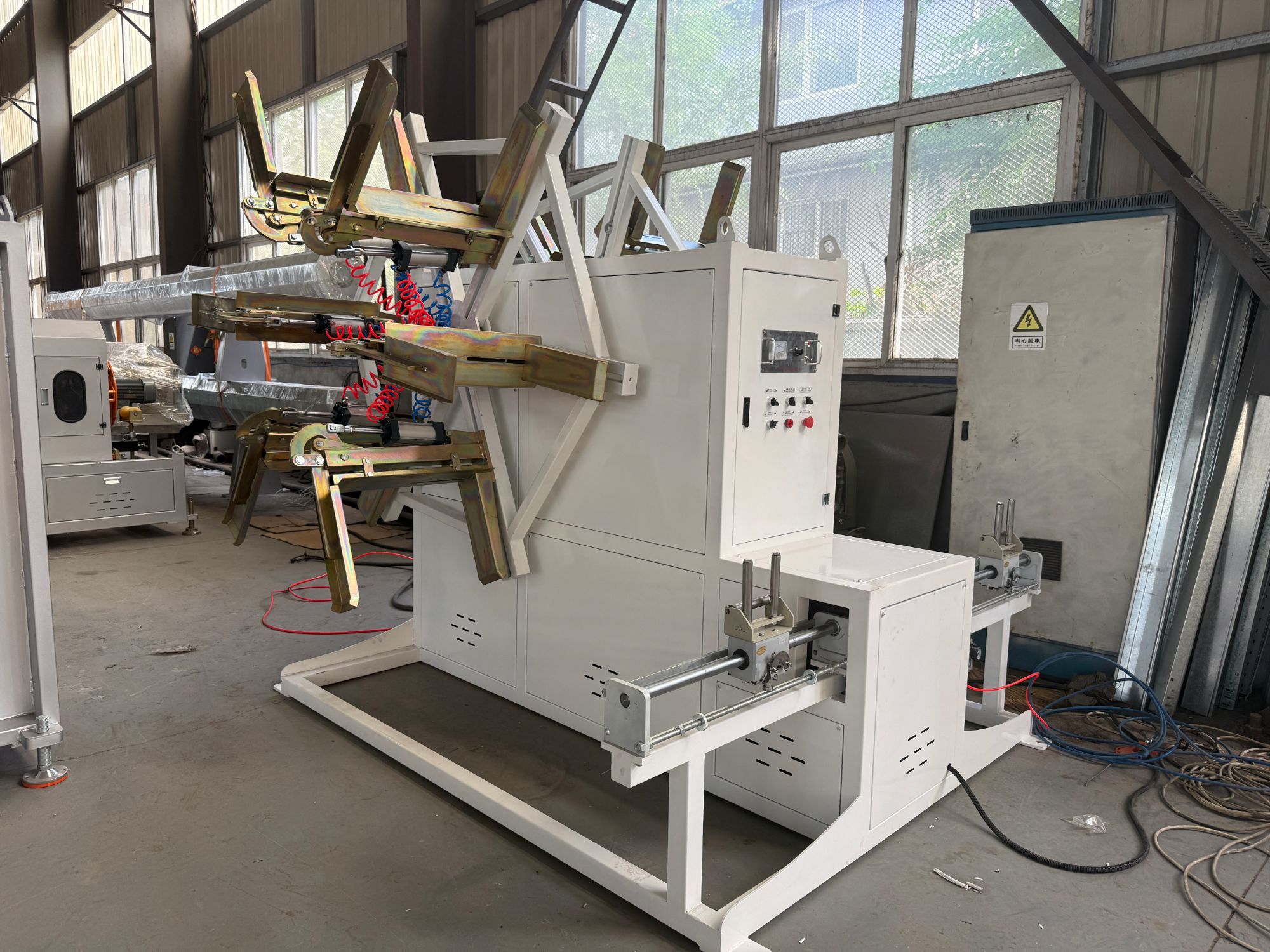
Every pipe extrusion line has its own quirks—material viscosity, melt temperature sensitivity, output rate targets. Off-the-shelf screw geometries force you to adapt your process to the machine, but custom profiles flip that logic. By tailoring the compression ratio, flight depth, and barrier clearances to your specific resin and die design, you eliminate common bottlenecks like surging, overheating, or insufficient mixing. The result is a screw that pushes melt forward with consistent pressure, keeping the pipe wall uniform from start to finish.
Stable output is not just about speed—it is about predictability. A custom screw profile reduces residence time variations inside the barrel, which means fewer degradation spots and less chance of black specks or weak weld lines. For high-output lines, this translates to longer uninterrupted runs and fewer scrap batches. Engineers often find that a well-matched screw profile lets them increase line speed without trading away dimensional accuracy or surface finish.
The biggest advantage shows up during changeovers and multi-layer pipe production. Instead of forcing one general-purpose screw to handle widely different melt flows, you can run dedicated profiles for HDPE, PP, or foamed core layers. This keeps each extruder operating near its sweet spot, reducing energy waste and downstream cooling load. Over time, the custom investment pays for itself in lower scrap rates and more consistent pipe ovality—even when the production schedule gets aggressive.
Closed-loop gauge control keeps wall thickness uniform
In pipe and tube extrusion, wall thickness often drifts as melt temperature, screw speed, or puller tension changes. A closed-loop gauge control keeps this in check by continuously comparing ultrasonic or laser readings against a target value. When the measured thickness starts to wander, the controller makes small corrections to the die centering bolts or line speed, pulling the wall back into tolerance before a long defect can form.
The real advantage over manual checks is that correction happens while the line is still running. Operators no longer have to stop the line, cut a sample, measure it by hand, and then guess at an adjustment. Since the loop updates every few seconds, shifts caused by material lot changes or barrel temperature swings are absorbed almost as soon as they appear. That translates into more consistent product, less scrap at the cutoff saw, and far fewer customer complaints about uneven wall.
Quick-change downstream tooling for multiple pipe sizes
Swapping dies or guides between production runs eats up time that could be spent bending tube. A quick-change downstream setup removes that bottleneck by letting operators exchange size-specific contacts, clamps, and rollers in under a minute without realigning the entire carriage. The keys are a shared mounting plate with locating pins and a tool cart that keeps each size set together, so there is no hunting for the right spacer or shim mid-shift.
Rather than forcing one set of rollers to handle a wide range of diameters, dedicated downstream clusters are matched to narrow pipe-size bands. This gives cleaner support through the bend, less marking on coated or polished surfaces, and more consistent wall thinning control. Changing over a full set becomes a two-bolt operation, and the parts are light enough that one person can manage it without a hoist.
Shops running three or more pipe sizes in a day see the biggest payoff. Setup time drops from ten or fifteen minutes per size to about forty seconds, and the repeatability means the first article after a changeover is already on target. Since every component is stored in its own labeled tray, wear is easier to track, and replacement parts can be ordered by the same size code that appears on the work order.
Low-energy barrel heating and internal pipe cooling
Rather than wrapping the barrel in thick external heaters that bleed heat into the surrounding air, a low-energy approach embeds heating elements directly into the barrel wall or uses induction coils that target only the steel mass. This cuts warm-up time and running wattage because almost no energy escapes to the environment. The barrel reaches setpoint faster, holds temperature with tighter swings, and draws far less current during steady-state extrusion or injection cycles.
Internal pipe cooling flips the same idea on its side: instead of relying on an outer water jacket with its thermal lag and uneven chill, coolant runs through narrow-bore channels drilled close to the melt path. These passages pull heat out where it actually builds up, so zones can be trimmed independently. A hot spot near the feed throat gets a quick pulse of water without overcooling the metering section, which keeps the melt viscosity stable and prevents degradation from runaway friction heat.
Together, low-energy barrel heating and internal pipe cooling create a faster-responding thermal system that uses measured energy rather than brute force. Startups shorten because the steel itself heats first, and cycle times drop because heat is removed on demand instead of being left to soak away. The result is a machine that runs quieter, consumes fewer kilowatt-hours per kilogram of output, and requires less babied tuning to hold a narrow processing window.
On-site commissioning with documented process recipes
When a line gets installed halfway across the world, the commissioning team rarely has the luxury of extended trial runs. Documented process recipes change that. Instead of relying on a technician's memory or a stack of handwritten notes, everyone works from the same set of parameters—temperature curves, dwell times, pressure limits, even valve sequencing. The first time we ran a new coating system in a humid climate, the documented recipe let us isolate a condensation issue to a single dew point threshold rather than re-tuning the entire sequence.
Each adjustment made on site gets captured back into the recipe file with a timestamp and a reason code. That level of detail matters when the plant's own engineers take over. They can see not just what was changed, but why the original spec didn't hold up under their utility conditions. On a recent dairy processing install, the recipe notes from commissioning saved the local team three weeks of guessing on CIP cycle timing because they could trace the rationale behind a 40-second rinse extension.
The payoff appears a month later, when a second shift operator pulls up the same documented recipe and gets consistent output without shadowing a veteran. It also helps during audits—every parameter has a paper trail tied to the commissioning date. We rarely talk about this as a deliverable because it feels like housekeeping, but the plants that treat commissioning recipes as living documents are the ones that hit full production targets without a second round of on-site fixes.
FAQ
The standard line runs pipe from 16 mm up to 1600 mm outside diameter, with wall thickness between 2 mm and 120 mm depending on the die and calibrator set. It handles PE80, PE100, PE100-RC, and PE4710 grades for pressure classes from PN4 to PN25, plus drainage and cable duct profiles.
We use gravimetric dosing on every extruder, paired with an ultrasonic scanner that measures wall thickness at eight points around the circumference. The control loop adjusts die centering and haul-off speed automatically, so the tolerance stays within ±0.5% even when output exceeds 1,200 kg/h on the 800 mm line.
A trained crew can switch from a 110 mm to a 250 mm pipe in about 45 minutes because the vacuum tank, haul-off, and cutter all ride on quick-lock linear rails. Die heads use split construction, and the calibration sleeves are cartridge-mounted, so no overhead crane is needed for most size changes.
The extruder barrel uses ceramic-insulated heater bands that cut surface losses by roughly 18%, and the vacuum pumps run on variable-frequency drives tied to actual tank pressure. The cooling water loop includes a heat exchanger that returns waste heat to the plant's heating system, lowering total line energy draw by around 22% compared with older fixed-speed setups.
Yes. The base frame and control cabinet are pre-wired for a co-extruder and a corrugator interface, so adding a second 45 mm extruder for a striped or multi-layer pipe takes about two days. The main PLC has the recipe structure for three-layer, striped, and corrugated profiles already loaded, so reconfiguration is mostly mechanical.
We send two process engineers for mechanical commissioning and a separate automation engineer for the control system. They stay through the first full production run of each pipe size the customer orders and train the operators on die setup, recipe selection, and fault recovery. After that, remote diagnostics over a VPN are available 24/7, with spare parts dispatch from a regional warehouse within 24 hours.
The line controller logs diameter, wall thickness, melt pressure, haul-off speed, and raw material lot numbers every 10 seconds. Each finished pipe gets a laser-marked code that ties to that log, so a customer can pull a full production record by scanning the pipe. Reports export to PDF or CSV and can be sent automatically to your MES or ERP system.
Conclusion
Our HDPE pipe production lines are built around extrusion technology specifically tuned for high-molecular-weight resins, delivering consistent melt quality that directly supports efficient, high-volume manufacturing. Rather than relying on generic screw designs, we engineer custom screw profiles for each customer's resin and diameter range, enabling faster line speeds without surging or excessive shear. This stability feeds into a closed-loop gauge control system that continuously measures wall thickness and adjusts haul-off speed or melt pressure, so pipes stay within tight ovality and thickness tolerances from start-up to full production. The result is less scrap, fewer operator interventions, and a line that holds its process window even during long runs.
Downstream, quick-change tooling lets a single line switch between multiple pipe sizes in under an hour, which is critical for plants serving varied municipal and industrial orders. We also reduce operating cost and thermal stress through low-energy barrel heating zones and internal pipe cooling that draws heat from the inside out, shortening cooling length and improving surface finish. Commissioning is handled on-site by our engineers, who leave behind documented process recipes for every size and material combination—so your team can restart a proven setup without guesswork. These capabilities combine to make our HDPE pipe lines a practical choice for manufacturers who need dependable output, lower energy use, and repeatable quality across a broad product range.
Contact Us
Contact Person: LISA LEE
Email: [email protected]
Tel/WhatsApp: +86 13780696467
Website: https://www.qdpipemachine.com