

OEM UV Resistant Engraving Plastic in China: Durable, Fade-Proof Marking Solutions
2026-11-02
Few things undermine industrial safety and traceability faster than labels that bleach, crack, or peel under UV exposure. Yet most engraving plastics still fail within two years outdoors. That’s the gap LYSHIRE targets with its OEM UV resistant engraving plastic—manufactured in China but engineered for far more demanding conditions. In this post, we’ll break down what makes these sheets genuinely fade-proof, where they outperform standard stock, and how to spec them for your next run.
How UV-Stable Engraving Stock Holds Up Under Harsh Sunlight
Sunlight breaks down most plastics within a few seasons. The UV radiation fractures polymer chains, causing fading, brittleness, and surface chalking. UV-stable engraving stock is formulated differently. Manufacturers add hindered amine light stabilizers (HALS) and UV absorbers directly into the substrate during extrusion, not just as a surface coating. This means the protection runs through the entire thickness. You can cut, bevel, or rout the material and the exposed edges still resist degradation instead of becoming weak points.
Under prolonged exposure in places like Arizona or the Australian outback, standard two-ply acrylics start to yellow and lose their impact strength after roughly 18 to 24 months. A properly stabilized engraving laminate, by contrast, typically holds its color and mechanical properties for five to seven years outdoors. The cap layer doesn't peel away from the core because the thermal expansion rates are matched more closely. Engraved text remains crisp, and the contrast between the surface and the core stays readable even when the sign faces direct afternoon sun for hours each day.
One practical test is to leave a scrap piece on a south-facing roof for a summer. Lower-grade stock will show a measurable shift in gloss and a chalky residue that rubs off on your finger. UV-stable grades may lose a little initial gloss, but they won't chalk, and the engraved details won't fill with micro-cracks. For signage that has to survive years without replacement, choosing a stock that is stabilized through the core, not just coated, is the difference between a sign that looks abandoned and one that still reads clearly at the end of its service life.
Custom OEM Production Runs That Match Your Exact Specifications
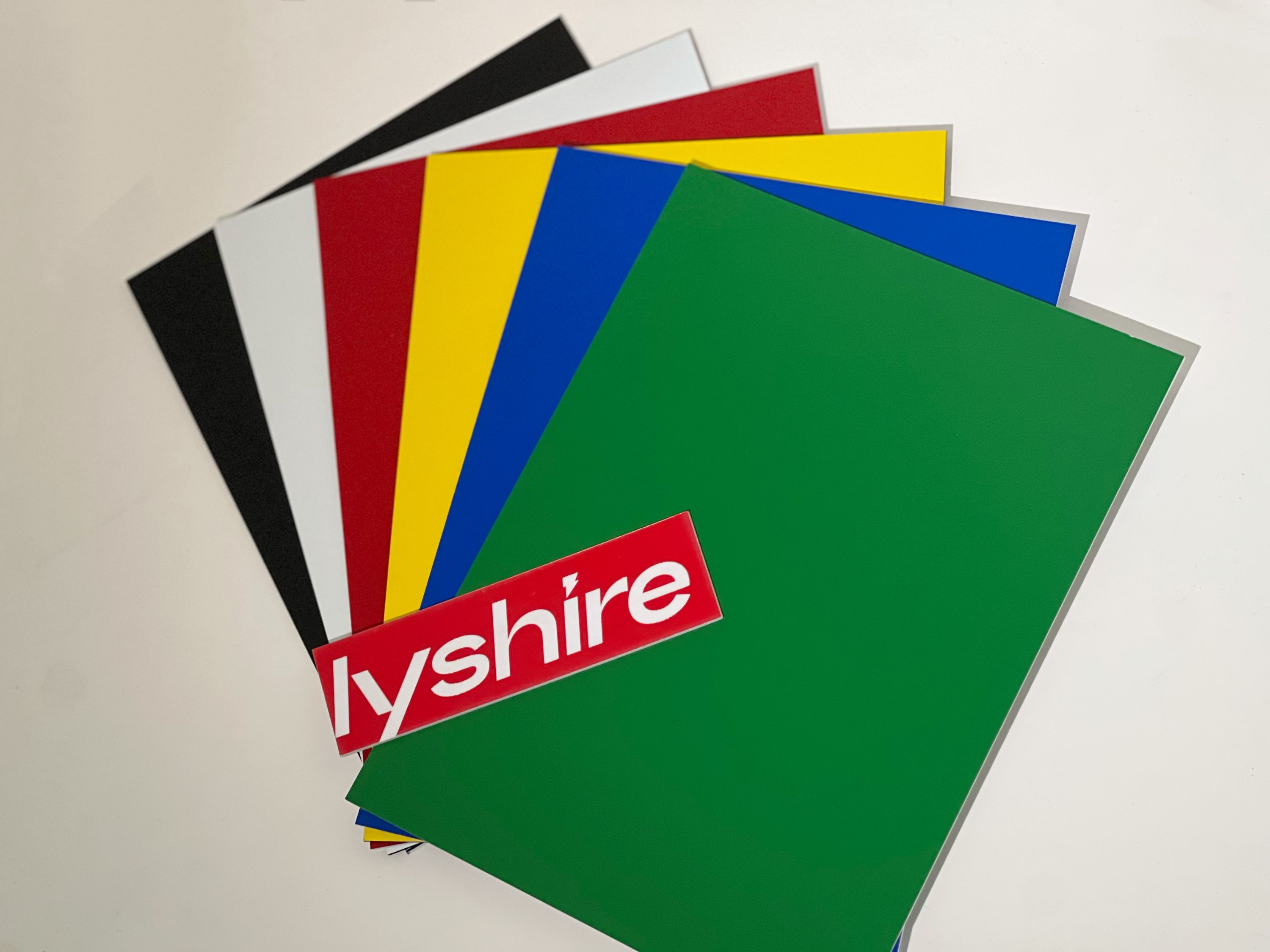
When your product calls for a non-standard size, a unique material blend, or a finish that off-the-shelf components simply can't deliver, our OEM runs are built around your drawings and tolerances—not the other way around. We start with a technical review of your specs, then adapt tooling, cycle times, and quality checks to match the exact parameters you submit, so the parts arrive ready for your assembly line without extra rework.
Small-batch flexibility is baked into the process. Whether you need a few hundred units to validate a new design or a phased ramp-up to full production, the line can be reconfigured quickly without sacrificing repeatability. Our engineers keep a close eye on dimensional drift, surface finish, and material consistency at every stage, and we document those measurements so you can trace each lot back to its raw material batch.
For proprietary designs or components with tight intellectual property concerns, we can also run dedicated cells with restricted access and custom packaging that matches your downstream handling. That way, the parts that arrive at your dock are already sorted, labeled, and packed according to your warehouse workflow—cutting down on inbound inspection time and keeping your production schedule intact.
The Chemistry Behind Fade-Proof Markings and Color Retention
Fade resistance starts at the molecular level. Organic dyes tend to break down because their chromophores—the parts of the molecule responsible for absorbing visible light—are vulnerable to UV photons. Each absorbed photon can cleave a bond or trigger an oxidation cascade, gradually bleaching the color. Inorganic pigments like iron oxide red or carbon black avoid this by having tightly bound crystal lattices. Their color comes from electron transitions in a stable mineral structure, not from a delicate chain of conjugated double bonds. Titanium dioxide is often added as an opacifier, scattering light before it can reach more fragile colorants.
Binders and stabilizers do the rest of the work. A fade-proof marking isn't just pigment suspended in a carrier; it's a carefully balanced film. Hindered amine light stabilizers (HALS) intercept free radicals before they attack the pigment or the resin. UV absorbers such as benzotriazoles convert high-energy radiation into harmless heat. The resin itself matters too—acrylics and polyurethanes form a tighter, less porous network than alkyds, keeping oxygen and moisture away from the pigment particles. When these elements work together, the marking can sit in direct sunlight for years without losing its original hue.
Industrial Applications Where Durable Tags and Labels Earn Their Keep
In automotive assembly plants, durable tags and labels take a beating from grease, solvents, and constant vibration. A flimsy paper label would peel off before the engine block cools, but a polyester or anodized aluminum tag stays put through the entire lifecycle of the vehicle—from the weld shop to the dealer lot. These markers carry torque specs, fluid types, and VIN data, and they need to survive not just the factory floor but also years of under-hood heat and road salt. When a technician pops the hood on a five-year-old car, the label better still be legible or warranties and safety recalls become a guessing game.
On the opposite end of the spectrum, chemical processing plants use labels that face corrosion from acids, alkalis, and steam cleaning. Here, the label isn't just a convenience—it's a compliance requirement. Pipe markers, valve tags, and equipment nameplates must withstand washdowns with caustic solutions and still show the hazard diamond or asset number clearly. Thermal transfer printed labels on ceramic or metal substrates often outlast the equipment they're mounted on, which is exactly the point: if the tag fails, the operator loses critical safety information. The label's durability becomes a silent partner in accident prevention.
Heavy machinery in mining and construction sites brings another layer of abuse—UV exposure, airborne dust, and physical impact. Durable labels here are often recessed into metal plates or covered with a thick polyurethane dome to resist scraping from rocks and debris. A backhoe's controls, a crane's load chart, or a generator's maintenance schedule all rely on tags that stay readable through years of outdoor punishment. Replacing a faded or cracked label on site isn't a quick office task; it means downtime and lost production. So the materials chosen—think brushed aluminum, laminated polycarbonate, or even engraved stainless steel—are picked for one reason: they don't quit when the environment gets ugly.
Comparing Chinese Manufacturing Partners for Consistent Quality and Lead Times
When evaluating Chinese manufacturers, surface-level promises about quality and delivery rarely hold up under real production pressure. A partner's track record with repeat orders often says more than any audit checklist, because consistency is built into their daily routines, not just their marketing deck.
Lead time reliability depends heavily on how a factory manages material buffers and schedules across multiple client orders. Some suppliers quietly reserve capacity for priority accounts, while others treat every order as a first-come, first-served queue. Asking about their buffer stock policy and how they handle rush reorders can reveal whether their stated lead times are realistic or just optimistic.
Quality stability tends to correlate with a factory's in-house process control rather than final inspection alone. Comparing partners means looking beyond defect rates to how they document root causes after a batch fails, and whether they adjust tooling or training before the next run. The best manufacturers treat every new order as a chance to refine their standard work, not just repeat it.
Surface Finishes and Textures That Make Engraved Details Pop
A smooth, mirror-polished base does more than shine—it throws every cut line into sharp relief. When light hits the surface, the engraved grooves interrupt the reflection, making even hairline details read clearly from across a room. For metals like brass or stainless steel, a quick buff before engraving transforms shallow markings into crisp, legible contrast.
Brushed or satin finishes work differently, catching light at a lower angle and giving engraved areas a soft, tactile glow. This texture hides minor surface wear while still letting recessed lettering or patterns stand out. Wood takes on a similar effect after fine sanding: the grain becomes a quiet background, and the carved portions absorb shadow, adding visual weight without extra depth.
For a bolder statement, combine textures—leave the surrounding area lightly sandblasted and the engraved lines polished. The matte field pushes the shiny grooves forward, creating a dimensional pop that feels intentional rather than accidental. Even on stone or acrylic, a subtle texture shift between the face and the cut edge is often enough to make details feel carved rather than printed.
FAQ
Standard plastic tends to yellow and become brittle under prolonged sun exposure. UV resistant engraving plastic contains stabilizers that preserve both color and structural integrity, making it far more reliable for outdoor labels and signs.
Absolutely. OEM services allow you to specify exact dimensions, thickness, corner radii, and even intricate cutouts. Laser cutting and CNC routing can reproduce your CAD drawings with tight tolerances.
The material undergoes accelerated weathering tests simulating intense UV radiation, salt spray, and temperature cycling. Even after years of exposure, the printed or engraved graphics retain their contrast and legibility.
You'll find it on outdoor equipment nameplates, safety warning signs, electrical panel labels, marine dashboards, and automotive interior tags. Any application where sunlight and abrasion are daily challenges benefits from this material.
Both methods work well. Laser engraving produces crisp, high-contrast text and fine details, while rotary engraving gives a tactile, three-dimensional feel. The choice depends on the desired finish and readability requirements.
Common stock ranges from 0.5 mm to 3 mm, but custom thicknesses can be produced for larger orders. Thinner sheets work for overlays and labels, while thicker stock suits rigid nameplates and machine tags.
Pair the plastic with an outdoor-rated acrylic foam tape or silicone adhesive. Proper surface preparation, such as cleaning with isopropyl alcohol and avoiding application below 10°C, also greatly extends bond life.
Prototype samples usually ship within 3 to 5 working days. Batch production typically takes 7 to 15 working days after artwork approval, though rush orders can often be accommodated for an additional fee.
Conclusion
Finding an engraving plastic that actually holds its color under relentless sunlight isn't as straightforward as most spec sheets suggest. The difference comes down to UV-stable chemistry: pigments are dispersed through the core rather than sitting on the surface, so even years of exposure won't turn bright whites chalky or reds into washed-out pinks. That durability matters most when tags live outdoors on transformers, chemical drums, or cable runs—places where a faded label stops being a nuisance and starts being a safety problem. Add in surface finishes that range from matte to high-gloss, and the engraved details stay sharp without glare washing them out in direct light.
On the OEM side, Chinese production has moved far beyond one-size-fits-all blanks. The real value is in matching exact thickness, sheet size, and even color batches to a client's existing inventory, so replacement tags blend seamlessly with ones made years earlier. That level of control comes from comparing factories not just on price, but on how they handle lead times, quality checks, and small-batch trial runs before full production. It's a quieter kind of reliability—no dramatic promises, just stock that arrives consistent and cuts cleanly on laser or rotary engravers, ready for the next industrial environment that expects markings to outlast the equipment they're attached to.
Contact Us
Contact Person: Tina Hou
Email: [email protected]
Tel/WhatsApp: +86 17816238685
Website: https://www.lyshire.com