

Top 10 PTFE Sheet Factories in China You Should Know About
2026-09-07
China is home to hundreds of PTFE sheet factories, but only a handful deliver consistent quality, tight tolerances, and reliable lead times. In this guide, we cut through the noise to highlight the top 10 manufacturers worth your attention. Among them, Kaxite has earned a reputation for precision and dependable service. Whether you're replacing an existing supplier or entering a new market, this list will give you a head start.
Thickness control and surface finish: where top PTFE sheet factories earn their reputation
Walk into any high-end PTFE sheet plant and you'll notice the same quiet obsession: calipers resting on every workbench, thickness logs filled in by hand, and a finishing area where the air smells faintly of buffing compound. The best factories don't just hit a tolerance band of ±0.005 inches—they chase the centerline with a kind of stubborn pride. This happens because PTFE cold-flows under load, so a sheet that measures perfect at rest can behave differently once clamped, bolted, or squeezed into a gasket groove. Top manufacturers compensate by mapping thickness across the entire width, not just three sample points, and by adjusting the skiving or pressing parameters in real time. The result is a sheet that lays flat without waves, resists bridge-thinning, and gives the fabricator a predictable base for further machining.
Surface finish is where the reputation gets earned in ways a spec sheet can't capture. A mirror-gloss surface looks impressive but can trap air when laminated or cause slippage in certain feed applications. A factory that knows its craft will offer controlled roughness options—typically in the 12 to 40 microinch Ra range—achieved through different etching, blasting, or post-skiving treatments. The subtlety lies in how evenly that roughness is distributed. Poor finishing leaves directional streaks or high spots that show up only after the first thermal cycle. Leading PTFE sheet producers use cross-hatched measurement grids and laser profilometry not as a marketing prop, but because they've seen a 0.0002-inch mismatch ruin a customer's downstream yield. That hard-won knowledge is what separates a commodity supplier from a partner worth staying with.
Practical buyers learn to test both properties together: run a gloved hand across the sheet in two directions, watch how it sits on a flat granite plate, and ask for a thickness heat map instead of a single average number. If a factory hesitates to share that map or can't explain how their surface finish changes after post-curing, that hesitation is your answer. The truly top-tier operations welcome the scrutiny. They know that in a material as unforgiving as PTFE, thickness and finish aren't cosmetic—they're the difference between a seal that fails in six months and one that survives a decade of thermal swings.
Why resin grade and filler blend matter more than the factory's location
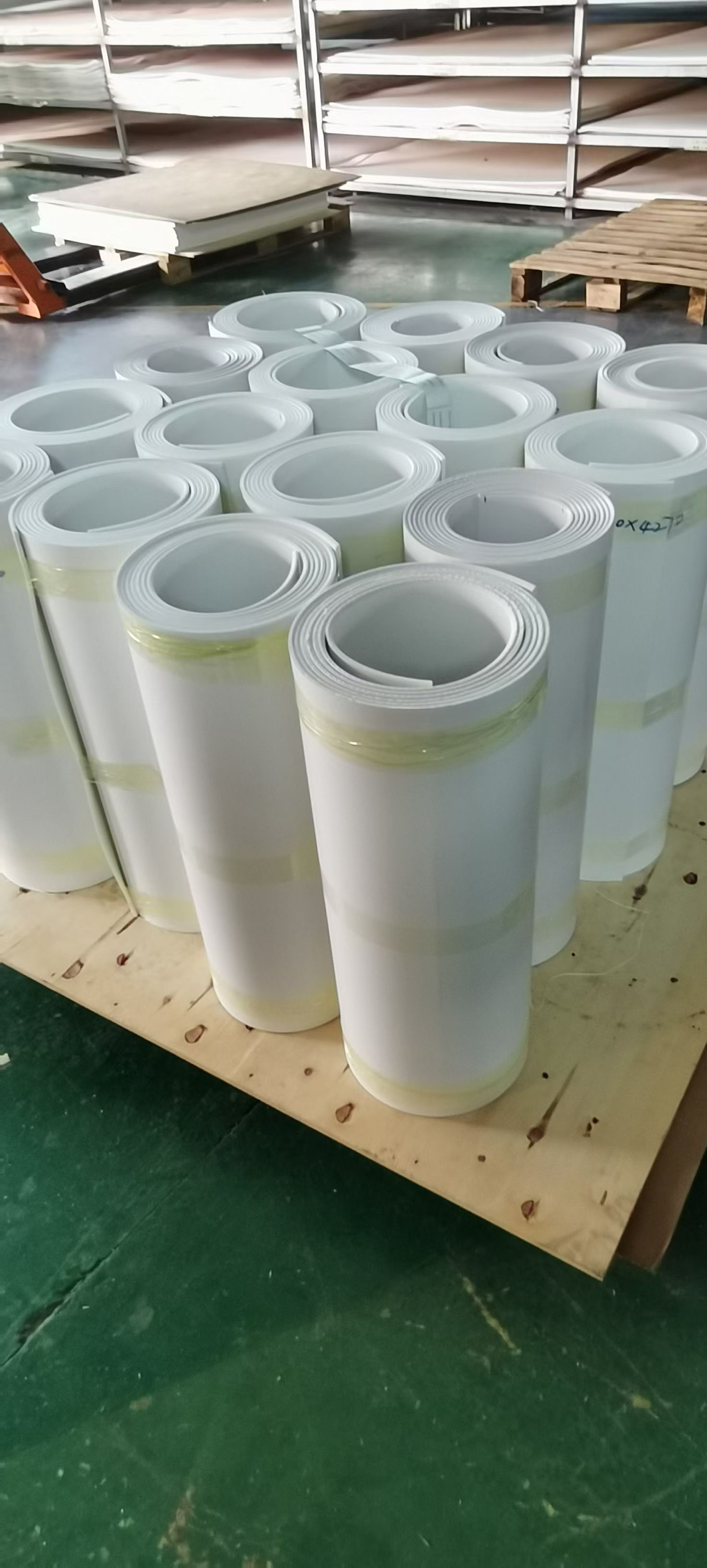
The resin grade sets the upper limit for what a part can do. Molecular weight, polymer backbone, and the built-in stabilizer package determine tensile strength, heat resistance, and how well the material holds up under UV or chemical exposure. No factory location can fix a resin that cracks under normal load or fades after a few months outdoors. Those failures are locked in the moment the wrong grade is chosen, long before the mold closes.
Filler blend is the next lever, and it often matters more than geography because it changes how the material behaves in the tool and in the field. Glass fiber content shifts stiffness and shrinkage; mineral fillers alter surface finish and cost; talc can reduce warpage but hurt impact. Two plants on different continents running the same resin and filler percentages will produce parts that are nearly identical. Change the filler blend by a few percent at one plant, and you can see dimensional drift, sink marks, or a jump in brittleness. That is a formulation issue, not a location issue.
Factory location still has a role in logistics, labor rates, and supply chain risk, but it is rarely the first thing that determines product quality. When engineers troubleshoot field failures, they usually find that a resin substitution or a filler source change caused the problem, not the country where the part was molded. Locking the material specification early, and keeping it stable, beats chasing cheaper labor every time.
Capabilities that separate a true PTFE sheet specialist from a general plastics workshop
Walk into a general plastics workshop and ask for PTFE sheet, and you might get a material that warps, creeps, or delaminates under load. A true specialist starts with resin selection—granular versus fine powder, virgin versus modified—because each changes how the sheet behaves when skived or molded. They control crystallinity and void content during sintering, then stress-relieve the billet before machining to prevent dimensional drift after delivery.
Fabrication is where the gap widens further. A specialist knows that PTFE’s high coefficient of thermal expansion means holding ±0.001" on a gasket requires temperature-stabilized tooling and staged machining, not just a sharp cutter. They also handle contamination differently: no shared lines with metal-filled polymers, dedicated tooling for high-purity grades, and packaging that avoids creasing. These are the invisible capabilities that keep a sheet flat, chemically inert, and dimensionally stable in service—not just at inspection.
The paperwork you should actually request: material certifications, test reports, and batch traceability
Material certifications and test reports are not just paperwork for the file. They tell you whether the steel, polymer, or coating actually meets the specified grade, heat treatment, or chemical resistance requirements. If you skip them, you inherit whatever the supplier chose to ship—and that can mean field failures, rework, or a recall down the line.
Ask for the mill test report or certificate of analysis for every critical lot. The test report should include actual measured values, not just pass/fail stamps. Compare those numbers against your drawing or specification, and keep a record of who signed off. A missing tensile strength or a vague 'conforms to spec' line is a red flag.
Batch traceability is what connects a finished part back to the exact raw material lot, production date, and operator. When something goes wrong, traceability is the only way to isolate the affected inventory without shutting down everything. Make the supplier provide a clear lot number on the packing slip and the invoice, and map it to your internal job number before the material enters your stock.
How to spot a factory that can handle custom sizes without compromising flatness
Look beyond the glossy brochures and ask direct questions about their flatness measurement methods. A factory serious about flatness will have in-house metrology tools like laser interferometers or granite surface plates, and they should be able to state the tolerance they hold per meter for different material thicknesses—not just recite a generic industry number. If they hesitate or only mention visual inspection, that's a red flag.
Custom sizes force the process to wander away from well-trodden settings, so pay attention to how they talk about clamping, stress relief, and material handling. Ask how they prevent bowing when cutting an unusually long or thin sheet, or how they manage thermal expansion during machining. The answer should involve specific techniques—like step cutting, symmetric stock removal, or post-process annealing—not vague promises of "high precision."
Finally, request sample coupons from the exact alloy and thickness you need, cut to an offbeat size you specify, and have them ship the pieces with a full inspection report. The willingness to do this, and the flatness data on the report, tells you more than any certification. A factory that grumbles or insists their standard sizes are "good enough" will likely cut corners when the dimensions get tricky.
Production scheduling quirks that affect lead times for PTFE sheet orders
Most fabricators batch PTFE sheet orders by thickness rather than by due date, which means a simple 1mm sheet can sit behind a queue of thicker panels waiting for the same calendar slot. This grouping saves changeover time on the compression molding presses, but it quietly stretches lead times for thinner gauges that customers often assume are quick to produce.
Another wrinkle is the sintering cycle, which cannot be rushed without risking internal voids or warpage. If a furnace is already loaded with large-diameter billets, smaller sheet blanks get shuffled to the next available window, regardless of the order’s original priority. Planners rarely flag this delay because the system treats the furnace as a shared resource, not as a constraint tied to specific sheet dimensions.
Tooling prep adds a further hidden lag. Press platens and caul plates need periodic reconditioning, and if a sheet order arrives right after a high-temperature run, the crew may wait hours for surfaces to cool and stabilize. These scheduling quirks rarely appear on standard lead-time quotes, yet they account for a meaningful share of the gap between promised and actual ship dates.
FAQ
The list typically includes Dongyue Group, Zhejiang Juhua, Shandong Huafu, Jiangsu Meilan, Shanghai 3F New Materials, Zhonghao Chenguang, and a handful of specialized converters around Wenzhou and Deqing. Each has different strengths, from raw resin integration to precision skiving.
Look beyond the glossy brochures and ask for actual skived sheet thickness tolerance data, virgin PTFE certification, and a sample batch from the same line that would run your order. A factory's willingness to share production records often reveals more than its annual output figure.
Molded sheets tend to have higher density and better dimensional stability, while skived sheets offer tighter thickness control for thin gauges. The top factories usually run both lines, but the ones with in-house resin production can control impurity levels from the start.
Shandong and Zhejiang dominate, with clusters around Zibo, Wenzhou, and Huzhou. Jiangsu also has a strong presence, especially for filled PTFE grades. Being near fluoropolymer raw material plants gives some of these factories lower logistics costs and faster resin turnaround.
Most of the top ten can compound glass fiber, carbon, bronze, or graphite into PTFE sheets. The real differentiator is whether they do their own blending or outsource it. In-house compounding usually means better dispersion and fewer resin-rich spots in the finished sheet.
It varies widely. Large integrated producers may ask for at least 500 kg per size for standard sheets, while smaller specialty converters are often willing to start at 50 kg if you accept their stock thickness list. Custom thicknesses usually push the MOQ higher.
Yes, a few smaller players in Deqing and Yangzhong specialize in ultra-thin skived PTFE films and sheets down to 0.05 mm. They rarely appear in big directories but outperform bigger names on precision and short-run flexibility for electronic and medical applications.
For standard 1-5 mm sheets in virgin PTFE, expect 15-30 days after deposit if the factory has the resin in stock. Filled grades or odd thicknesses can stretch that to 45-60 days, especially during peak demand periods for chemical processing equipment.
Conclusion
When evaluating China's top PTFE sheet manufacturers, the first thing to check is how they handle thickness tolerance and surface finish. Reputable factories invest in precision calendering and skiving equipment that keeps thickness variation within a few hundredths of a millimeter, and they polish or texture the surface to match specific sealing or anti-stick applications. Just as important is the raw material: a top-tier factory will use virgin PTFE resin from brands like Daikin or Chemours, and if fillers are needed—glass, carbon, bronze—they control the blend ratio and dispersion carefully, because a poorly mixed filler creates weak spots that fail under pressure. This level of control separates a dedicated PTFE sheet specialist from a general plastics workshop that simply extrudes or molds whatever resin is cheapest. The best factories also run in-house testing for tensile strength, elongation, and dielectric properties, and they can adjust the process for different grades, from skived sheet to molded sheet, without losing consistency.
Beyond the production floor, the documentation and scheduling practices reveal a lot about a factory's reliability. You should ask for material certifications that trace the resin lot number, along with test reports for thickness, density, and mechanical properties, plus batch traceability records—if a factory hesitates to provide these, it's a red flag. Custom sizes are another differentiator: a true PTFE sheet specialist can cut large sheets or unusual dimensions while maintaining flatness, often by using stress-relieving heat treatment after machining. Finally, pay attention to production scheduling quirks. Many PTFE sheet orders are delayed because factories batch different thicknesses or filler types together to save on press changeover time, or they wait for a full oven load before sintering. Knowing these patterns helps you negotiate realistic lead times and avoid surprises.
Contact Us
Contact Person: Kaxite
Email: [email protected]
Tel/WhatsApp: 0086-574-87527771
Website: https://www.seal-china.com