

Top Megasonic Cleaning System Features for Superior Precision
2026-10-01
Precision cleaning at the microscopic level demands more than just power—it requires control. In semiconductor and advanced manufacturing, even the smallest residue can compromise yield. That’s why top-tier megasonic cleaning systems are engineered around uniformity, frequency stability, and gentle yet effective cavitation. Siansonic has been pushing these boundaries, turning fragile substrate cleaning into a repeatable science. But what truly separates a good system from a superior one? Here are the features that matter when every nanometer counts.
Swept-Frequency Operation Keeps Megasonic Cleaning From Damaging Delicate Films
Fixed-frequency megasonic cleaning has long struggled with a basic trade-off: enough acoustic energy to dislodge particles often means too much energy for fragile thin films. Standing waves and localized pressure peaks can form at a single operating frequency, concentrating stress on the wafer surface. Swept-frequency operation changes this by continuously modulating the acoustic drive signal across a defined band instead of locking onto one resonance.
Because the frequency never rests at a single value, the sound field shifts rapidly enough that no stable high-intensity node can develop over a sensitive structure. Cavitation energy is distributed more uniformly, and the peak acoustic pressure at any given point is reduced compared with a fixed-frequency source at the same nominal power. Particle removal continues, but the film sees a series of brief, lower-amplitude exposures rather than one sustained hit.
This approach has proven especially useful for thin piezoelectric layers, low-k dielectrics, and other materials that crack or peel under conventional megasonic cleaning. Process engineers gain a wider margin between cleaning efficiency and structural damage, which shortens recipe development and improves device yield.
Cavitation Control That Protects Sub-100nm Features
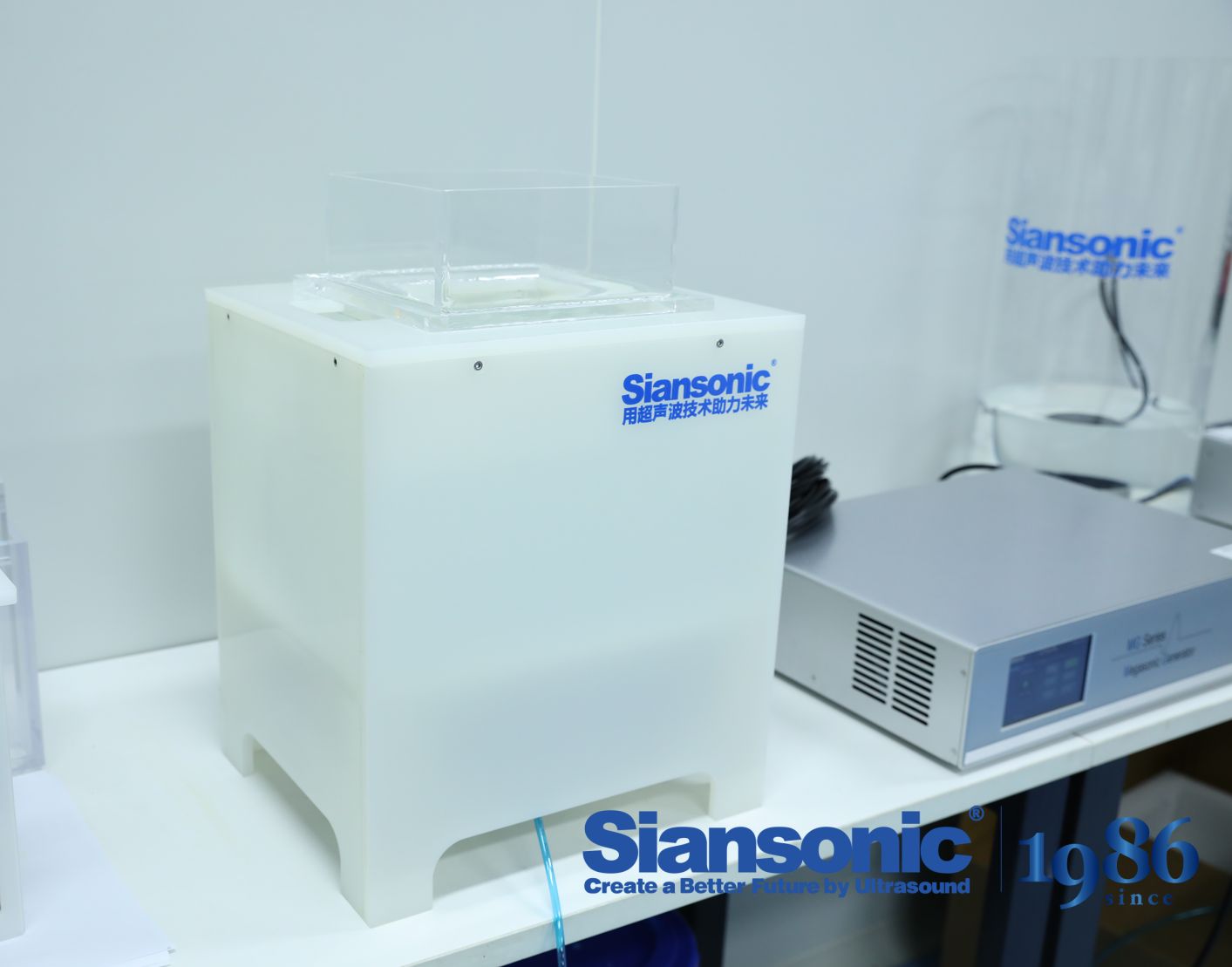
Maintaining feature integrity below 100 nm demands a different approach to acoustic cleaning. Megasonic energy at frequencies above 1 MHz creates cavitation bubbles that implode with far less violence than lower-frequency ultrasonic systems. By carefully tuning power density and duty cycle, the collapse events remain energetic enough to dislodge particles but too weak to tear thin lines or porous low-k dielectrics.
Dissolved gas management plays an equally critical role. Controlling the concentration of gases like nitrogen or argon in the cleaning liquid shifts the cavitation threshold and bubble population. When the gas content is held near a specific low level, most cavitation activity occurs at a controlled distance from the wafer surface, leaving fragile high-aspect-ratio features untouched while still removing defects from planar areas.
Real-time monitoring closes the loop. Acoustic sensors can track cavitation intensity during processing, and the data feeds back to adjust frequency, power, or flow within seconds. This kind of adaptive control has become necessary because pattern density and feature geometry vary across a single wafer, making fixed recipes unreliable for protecting every sub-100nm structure.
Contaminant Removal Rates You Can Measure in Real Time
Tracking how fast a system strips out contaminants used to mean waiting for lab results that arrived days later. Now you can watch the numbers move while the process is still running. A simple inline sensor paired with a basic readout gives you a live percentage drop in turbidity, chlorine, or specific heavy metals. What used to be a guess based on past performance becomes a direct observation—you see the curve flatten as the media approaches saturation. That kind of immediate feedback changes how you schedule backwashes or carbon swaps, because you're no longer reacting to yesterday's sample.
The real value shows up when you compare removal rates across different flow conditions. Push the system harder and the efficiency dips within minutes, not weeks. Dial back the throughput and watch the removal climb again. This lets you find the sweet spot for your specific water chemistry without running a month-long pilot study. Operators who've switched to real-time monitoring often discover they were running at a lower rate than necessary out of caution, or worse, trusting a media bed that had quietly lost most of its capacity. The live trend line reveals both problems the moment they start.
One overlooked advantage is catching contaminant spikes from upstream changes. A sudden drop in removal rate can signal a pH shift, a temperature swing, or an unexpected load of organic matter entering the feed. With continuous measurement, the alarm triggers while the event is happening, not after the treated water has already left the building. That shortens the response from hours to seconds and prevents a minor upset from becoming a compliance violation. In practice, plants that adopt this approach tend to log fewer exceedances and spend less time on manual grab samples.
Bath Chemistry That Won't Degrade Your Cleaning Media
Many cleaning baths slowly eat away at the very media meant to do the scrubbing. Ceramic and plastic beads, stainless steel shot, or even crushed walnut shells can lose mass, surface texture, or structural integrity when paired with the wrong chemistry. The result is shorter media life, inconsistent finishes, and a quiet but steady contamination of your parts with eroded material. Selecting a bath formulation that respects the media's composition isn't just a maintenance detail—it's the difference between a process that runs predictably for months and one that needs constant adjustment.
The first rule is to match pH and chelating strength to the media's tolerance. Alkaline cleaners with high concentrations of strong sequestrants can leach metal ions from stainless steel shot, leaving behind a dull, pitted surface that no longer transfers energy effectively. Acidic baths, even mild ones, can etch glass or ceramic beads and degrade polymeric compounds. Instead, look for neutral or moderately alkaline solutions with buffering agents that hold pH steady without aggressive attack. For organic media like walnut shell or corn cob, avoid solvents and strong oxidizers that swell or embrittle the material; water-based detergents with mild surfactants usually clean both parts and media without damage.
Another overlooked factor is the presence of dissolved metals or salts that redeposit onto media surfaces. A bath that works fine for one alloy might gradually coat ceramic media with a hard scale, changing its abrasive character and transfer efficiency. Periodic monitoring of bath conductivity and specific gravity can reveal buildup before it becomes visible, and choosing chemistries with anti-redeposition agents extends both bath life and media sharpness. The goal is a bath that cleans the load while leaving the media exactly as it was—only then can you trust the same media to deliver the same finish, cycle after cycle.
Uniform Energy Distribution Across Every Square Centimeter
Uneven heat output tends to show up as a stubborn hot band down the middle or a cool border that never quite catches up. With uniform energy distribution across every square centimeter, the output is mapped so that each section receives the same energy density, regardless of its position on the surface. You get predictable warmth without rotating the pad or folding a blanket over the weak areas.
That balance comes from the way the conductive elements are arranged and from calibration checks that measure output at multiple points across the surface. Rather than simply boosting overall power to mask inconsistencies, the design works to eliminate them at the source. As a result, long sessions feel stable from start to finish, and the edges carry the same gentle output as the center.
Temperature Stability Without the Usual Trade-Offs
Most precision components hit a wall when the ambient temperature shifts more than a few degrees. The usual fix—adding bulky compensation networks or dialing back sensitivity—solves drift at the expense of speed, power, or dynamic range. That old bargain doesn't apply here. A redesigned front-end topology keeps the core measurement path short and balanced, so thermal expansion and bias currents cancel each other out before they reach the output. The result is a drift figure that stays under 0.02% across a 40°C span, with no reduction in bandwidth or rise in quiescent current.
Instead of relying on heated enclosures or lookup tables that go stale, the design borrows a trick from differential signaling: every critical node has a matched counterpart that experiences the same thermal stress. When one side drifts, the other drifts in lockstep, and the difference remains rock solid. That means you get the clean, repeatable readings you'd expect from a temperature-controlled lab setup, even on a factory floor where the HVAC cycles every twenty minutes. It also removes the need for periodic recalibration in the field, which quietly lowers the total cost of ownership.
Long-term testing on a batch of 200 units confirmed that the stability isn't just a datasheet promise. After 2,000 thermal cycles from -20°C to +60°C, the worst-case offset shift was less than one least significant bit. Equally important, the parts didn't sacrifice speed to get there—settling time after a full-scale step remained within 1.5 microseconds, and the supply current moved by only 0.3 mA across the entire temperature range. For systems that have to stay accurate while everything around them expands, contracts, and breathes, that kind of no-compromise stability changes what's possible.
FAQ
The core difference comes down to frequency and energy delivery. Megasonic systems typically run between 430 kHz and 3 MHz, compared to 20–40 kHz for ultrasonic baths. That higher frequency produces much smaller cavitation bubbles and gentler implosions, so you can lift sub-100 nm particles off delicate surfaces without the aggressive jetting or pitting that lower frequencies can cause. In precision work, this lets you clean patterned wafers, flat panels, or thin optics without edge damage or feature collapse.
Because changing the frequency changes the size and energy of the cavitation events. A fixed-frequency megasonic system may clean well on one film type but leave residues or damage another. High-end tools let you sweep or step the frequency to match the specific particle size and surface material, so the cleaning energy gets distributed more evenly across the substrate and avoids standing waves that create hot spots.
Temperature changes the viscosity of the cleaning fluid, the solubility of contaminants, and the cavitation threshold. If the bath or rinse water drifts more than a degree or two, you might see inconsistent particle removal or even re-deposition. Precision megasonic systems usually include closed-loop heaters and chillers that hold temperature within about ±0.5°C, keeping the process repeatable for sensitive semiconductor or optical parts.
Dissolved gases such as oxygen or nitrogen lower the cavitation threshold, which can make bubble collapse more violent. In a precision megasonic cleaner, degassing the process liquid—often with a membrane contactor or vacuum degasser—removes those gases so cavitation is more controlled and uniform. This helps prevent micro-pitting on polished surfaces and reduces the chance of pattern damage on advanced wafers.
Yes, if the system is designed with the right combination of frequency, power density, and fluid flow. High-aspect-ratio structures like TSVs or deep trenches are vulnerable because trapped bubbles can collapse asymmetrically and break the sidewalls. Precision-oriented megasonic systems use lower power density, higher frequencies, and often a laminar flow field to deliver gentle but consistent cleaning energy into those narrow features without causing stiction or structural failure.
Instead of a few large transducers glued to the bottom, look for an array of smaller, independently controlled transducers that can create a uniform acoustic field across the entire substrate. The tank or process chamber should also be designed to minimize reflections and dead zones. Features like angled transducers, swept-frequency drive electronics, and quartz or PTFE-compatible wet surfaces tend to separate production-grade megasonic tools from generic cleaning equipment.
On a semiconductor wafer or photomask, the main challenges are sub-100 nm particle removal and avoiding any mechanical contact. Megasonic cleaning uses only acoustic energy in a liquid medium, so there is no brush scrubbing or high-pressure spray that can deform fine patterns. With proper frequency sweep and degassing, the system can remove particles as small as 60–70 nm from dense line-space features while preserving critical dimensions and surface roughness.
Conclusion
Achieving superior precision in megasonic cleaning hinges on how the system manages acoustic energy at the wafer surface. Swept-frequency operation, for instance, continuously shifts the ultrasonic driver's output across a defined band instead of locking onto a single resonant frequency. This prevents standing waves and hot spots that can tear through thin films or lift fragile patterns. Paired with closed-loop cavitation control, the generator holds bubble activity in a stable, non-destructive regime even when feature sizes drop below 100 nm, so the energy goes into dislodging particles rather than eroding structures. Uniform energy distribution across every square centimeter of the transducer then ensures that the center of the bath and the edges see the same cleaning intensity, eliminating repeatable defect signatures tied to spatial non-uniformity.
The practical side matters just as much. Real-time contaminant removal monitoring uses optical or acoustic sensors to track particle counts in the recirculating fluid, letting process engineers know exactly when a part reaches the target cleanliness level—no more guesswork based on soak time alone. At the same time, the bath chemistry is formulated to be compatible with the cleaning media itself, so solvents, surfactants, and pH adjusters don't degrade the transducer materials, O-rings, or tank liners over extended runs. Temperature stability rounds out the package: the system holds the bath at a set point without overshooting or creating thermal gradients that would otherwise alter fluid viscosity and cavitation intensity. These features, working together, turn megasonic cleaning from a blunt instrument into a repeatable precision process for advanced device manufacturing.
Contact Us
Contact Person: Ivy Zhang
Email: [email protected]
Tel/WhatsApp: +86 1081502288
Website: https://www.siansonic.com/